Count on capacity in your tournament
When arranging a tournament, you often want to get a feel early on for how the number of teams affects how many pitches you can have. At Cup Manager, we often help tournaments reason about how many teams they should accommodate, or if they should try to try to get hold of multiple pitches.
Here we would like to share some tips on how to think when calculating capacity in your tournament.
At the bottom, we have also built a calculator to help you calculate your own tournament.
Let's get started!
How many matches will there be in my tournament?
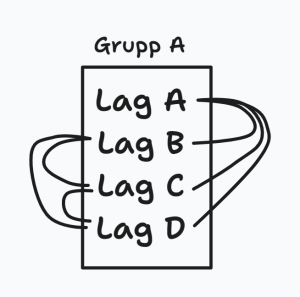
Assuming that all your groups are the same size, you know that each hold plays once against all opponents in the group. As we can see in the picture, each hold will play 3 matches in a 4-holds group.
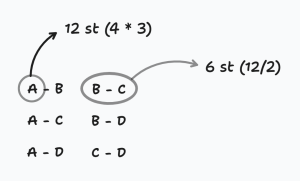
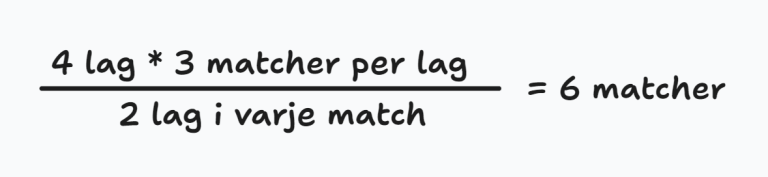
4 teams playing 3 games each? Then it is easy to believe that the total number of matches must be 3 * 4 = 12 matches ? But that is not true. Check again the number of lines/arcs in the image above. 12 is the number of times that any team appears in any match, but since there are two teams in each match, there will be half as many matches, i.e. 6 matches .
So there will be 6 matches in a four-team group:
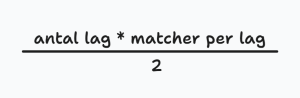
More generally, you can say that the total number of matches is:
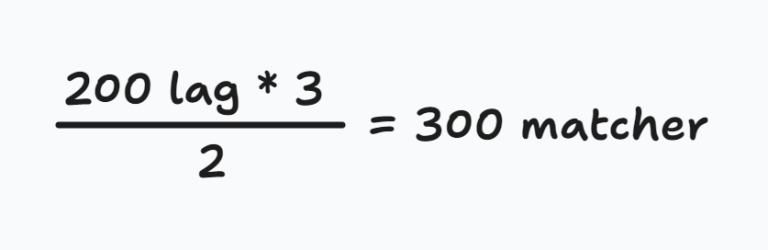
And the same formula can be used to calculate an entire tournament. For example, if you plan to have 200 teams in your tournament and everyone will play 3 matches (e.g. if you have 4-team groups), then there will be 300 matches.
Feel free to try inserting your own numbers.
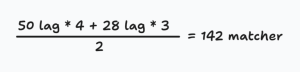
If you have different sized groups in different classes or other variations, you have to calculate each part separately and then add it up. For example, if you have 50 teams in five-team groups (4 matches per team) and 28 teams in four-team groups (3 matches per team), you can easily calculate the number of matches similar to the above.

But the playoffs then?
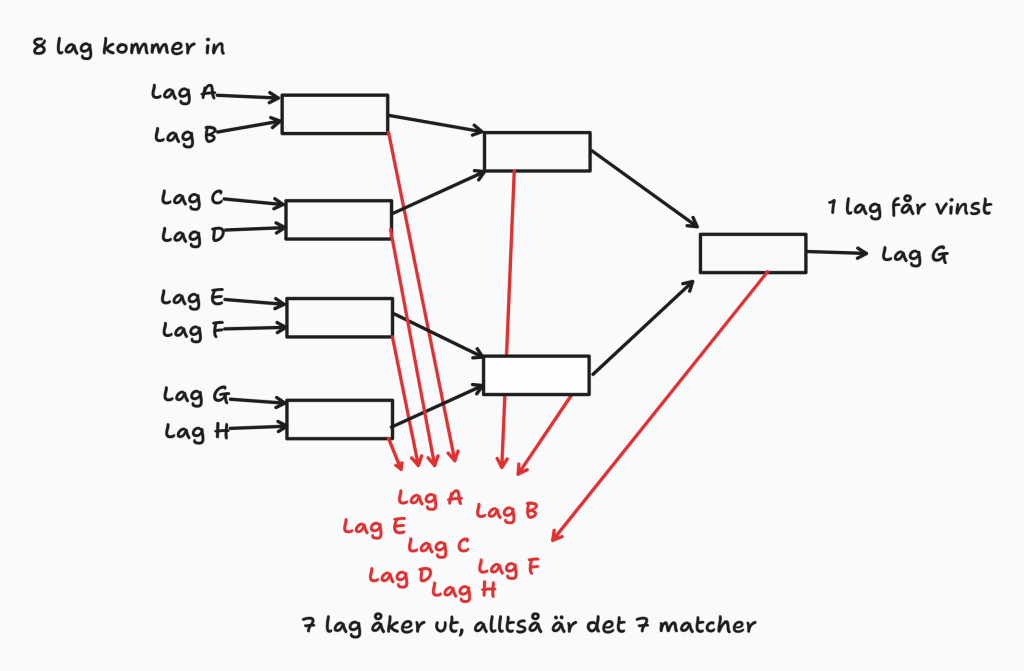
Yes, to calculate how many matches there are in a playoff, you can start with an insight: in a playoff tree, exactly one hold goes out in each match, and at the end, there is one hold left as the winner of the final. So the number of matches must be the same as the number of hold that enter the playoff, minus one. As an example, we can have a playoff that starts with quarterfinals. Then there are 8 hold that enter, and one hold that remains as the winner. Seven hold thus go out and so there are seven matches in the playoff tree.
This rule works even if the endgame tree is not "even" or balanced.
If you also have a bronze medal match in your playoff, there will of course be an extra match, i.e. as many matches as teams. If you have placement matches for all teams, then it's a bit more complicated.
Example: If we have 6 age groups with both A and B playoffs, we have 12 playoffs. If all 200 hold in our tournament advance to either A or B playoffs, the total number of playoff matches will be:
In our fictitious tournament, we thus have 300 group stage matches + 188 playoff matches = 488 matches in total.
Time
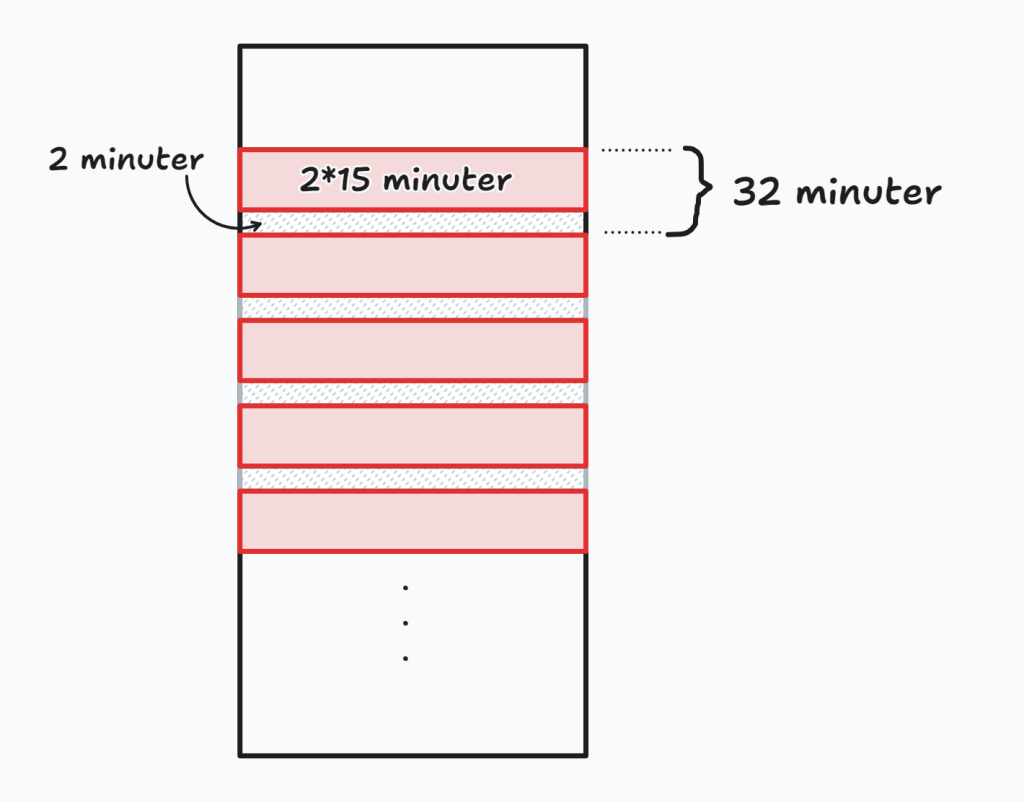
To take the next step to calculating time consumption, we need to know how long each match takes. A match has a length, e.g. 2×15 minutes, but also a break before the next match starts, e.g. 2 minutes. This means that the matches start 32 minutes apart.
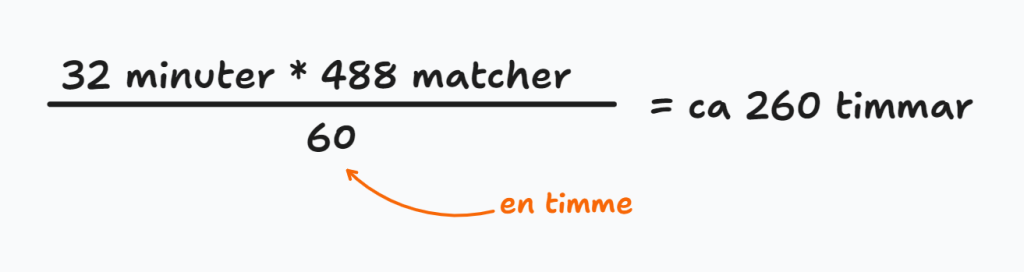
By multiplying the match interval by the number of matches, we can calculate that the total time required for the tournament is:
of which 160 hours group games and 100 hours playoffs.
Plans
Based on this, we can calculate how many plans we need depending on when we start in the morning and end in the evening.
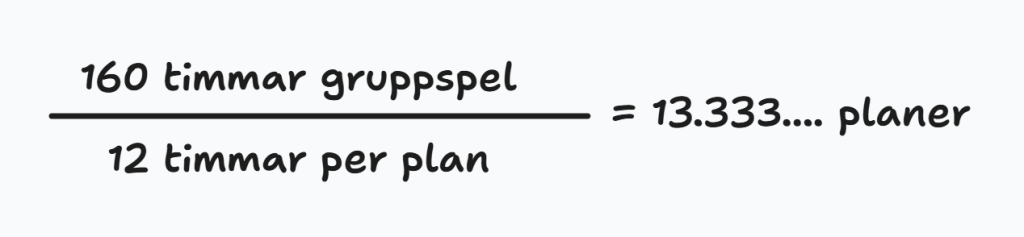
For example, if we are to play the entire group stage from 08:00 to 20:00 during one day, this means that we have 12 hours per field. Then we can easily calculate how many plans are required by taking the total time consumption and dividing by the number of hours we have per plan.
Rounded up, there are therefore 14 plans.
The same can be done for the playoffs.
However, it should be remembered that this gives us the minimum number of plans, assuming that all matches can be compressed completely and there will be no holes in the schedule at all. In practice, it is rarely possible to pack 100%, especially not in the playoffs where the matches are dependent on previous matches.
Below we have an interactive tool that allows you to calculate your own tournament.
Cupkalkylator
First a little about your tournament
(we assume here that all teams advance to the playoffs, and that there is no bronze medal match or other placement matches)
Calculate the number of playing fields
More curious?
We hope that this article and the tool helped you calculate the capacity of your tournament.
At Cup Manager we help tournaments daily to partly count on this but also to create fantastic game schedules for both small & large tournaments.
Please contact us to find out more and get a demonstration of what we can do for you.